

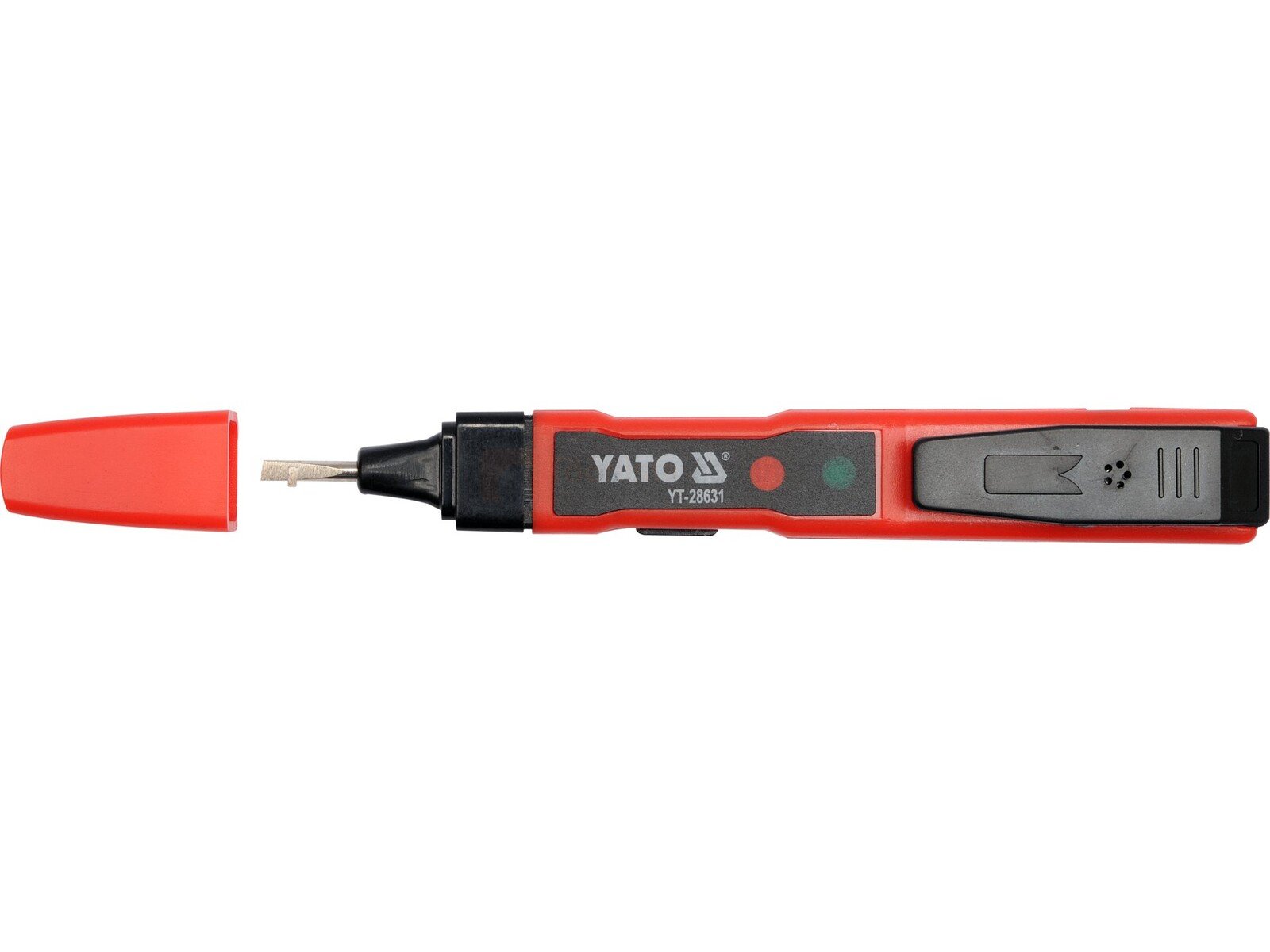
YATO voltage indicator 1.5-9 V DC, 70-250 V AC
Official YATO Dealer
- 100% genuine products
- Manufacturer warranty
- Professional consultation
Technical Specifications
Field of application: electrical work
Power source: battery
Battery type: 2 × 1.5 V; LR44
Length: 140 mm
Voltage: 1.5–9 V direct current (d.c.)
Voltage – non-contact test: 70–1000 V alternating current (a.c.)
Continuity test: 0–100 MΩ
Conductivity test: yes
LED indicators: yes
Measured voltage frequency: 50–500 Hz
Voltage – contact test: 70–250 V alternating current (a.c.)
Allows you to determine the presence of electrical voltage, detect alternating current (AC) voltage, for example, under plaster, as well as check the continuity of wires and the condition of batteries or accumulators. The presence of voltage is indicated by an LED diode in the tester body.
FUNCTIONS
AC voltage detection by contact method: 70–250 V
AC voltage detection by induction method: 70–1000 V
Battery check by contact method: 1.5–9 V
Wire continuity test by contact method: 0–100 MΩ
Sound and light signal (LED)
Adjusting the sensitivity of the tester by induction method: [H]igh – [L]ow
CONTACT METHOD
Allows voltage detection, battery check and continuity test. To check the phase in the socket, set the tester to the [O] position, then insert the blade into the socket opening. The red LED lights up to indicate the presence of a phase. In this method, it is not recommended to touch the contact on the side of the handle – this does not pose a risk of electric shock, but increases sensitivity and may give a false reading.
BATTERY CONDITION CHECK
Set the tester to the [O] position. Touching the contact on the side of the handle, place the blade on the "+" terminal of the battery and touch the "-" terminal with your other hand. The LED lights up to indicate that there is voltage in the battery. The tester allows you to check 1.5–9 V batteries and accumulators. This method should not be used to check batteries with a higher voltage or to test accumulators connected to a circuit.
WIRE CONTINUITY TEST
Set the tester to the [O] or [L] position. Touching the contact on the side of the handle, place the blade on one exposed end of the wire and grab the other end with your other hand. In the [O] position, the red LED indicates continuity, in the [L] position, the green LED lights up and a sound signal is heard. The continuity of energized wires should not be checked with this method.
INDUCTION METHOD
Allows non-contact detection of AC voltage, even under plaster. For example, to check the voltage in an insulated wire, set the tester to the [L] position. Holding the blade, bring the metal contact at the top of the handle close to the wire. The green LED lights up and a sound signal indicates the presence of voltage. The sensitivity can be increased by switching the button [L] → [H]. The method also allows non-contact detection of a break in an energized wire – the tester will no longer indicate voltage at the break. The tester can be turned and used through the end, but when searching for wires under plaster, avoid scratching the wall.
Field of application: electrical work
Power source: battery
Battery type: 2 × 1.5 V; LR44
Length: 140 mm
Voltage: 1.5–9 V direct current (d.c.)
Voltage – non-contact test: 70–1000 V alternating current (a.c.)
Continuity test: 0–100 MΩ
Conductivity test: yes
LED indicators: yes
Measured voltage frequency: 50–500 Hz
Voltage – contact test: 70–250 V alternating current (a.c.)
Returns & Warranty
Product returns
14-day right of withdrawal. Terms for consumers and business customers.
Return instructionsWarranty
All products come with manufacturer warranty as required by law.


Delivery time depends on stock
This product has no reviews yet. Be the first to rate it.
Product description
Allows you to determine the presence of electrical voltage, detect alternating current (AC) voltage, for example, under plaster, as well as check the continuity of wires and the condition of batteries or accumulators. The presence of voltage is indicated by an LED diode in the tester body.
FUNCTIONS
AC voltage detection by contact method: 70–250 V
AC voltage detection by induction method: 70–1000 V
Battery check by contact method: 1.5–9 V
Wire continuity test by contact method: 0–100 MΩ
Sound and light signal (LED)
Adjusting the sensitivity of the tester by induction method: [H]igh – [L]ow
CONTACT METHOD
Allows voltage detection, battery check and continuity test. To check the phase in the socket, set the tester to the [O] position, then insert the blade into the socket opening. The red LED lights up to indicate the presence of a phase. In this method, it is not recommended to touch the contact on the side of the handle – this does not pose a risk of electric shock, but increases sensitivity and may give a false reading.
BATTERY CONDITION CHECK
Set the tester to the [O] position. Touching the contact on the side of the handle, place the blade on the "+" terminal of the battery and touch the "-" terminal with your other hand. The LED lights up to indicate that there is voltage in the battery. The tester allows you to check 1.5–9 V batteries and accumulators. This method should not be used to check batteries with a higher voltage or to test accumulators connected to a circuit.
WIRE CONTINUITY TEST
Set the tester to the [O] or [L] position. Touching the contact on the side of the handle, place the blade on one exposed end of the wire and grab the other end with your other hand. In the [O] position, the red LED indicates continuity, in the [L] position, the green LED lights up and a sound signal is heard. The continuity of energized wires should not be checked with this method.
INDUCTION METHOD
Allows non-contact detection of AC voltage, even under plaster. For example, to check the voltage in an insulated wire, set the tester to the [L] position. Holding the blade, bring the metal contact at the top of the handle close to the wire. The green LED lights up and a sound signal indicates the presence of voltage. The sensitivity can be increased by switching the button [L] → [H]. The method also allows non-contact detection of a break in an energized wire – the tester will no longer indicate voltage at the break. The tester can be turned and used through the end, but when searching for wires under plaster, avoid scratching the wall.
Shipping & Delivery
Delivery time depends on stock
Returns & Warranty
Product returns
14-day right of withdrawal. Terms for consumers and business customers.
Return instructionsWarranty
All products come with manufacturer warranty as required by law.
Reviews
This product has no reviews yet. Be the first to rate it.
YATO voltage indicator 1.5-9 V DC, 70-250 V AC
YT-28631